I got my hands on a GR III as soon as they were available in the US, which was March of 2019. Since then it has become a constant companion through thick and thin, economic boom and pandemic turmoil alike. Though I use other cameras, the GR III is small enough to ride along with a larger kit, and to accompany me on non-photographic missions.
The GR III was a highly anticipated camera, and the internet was awash with user reviews and opinions soon after release. I found I didn’t care to add to the noise at the time, but now that I have over two years with the camera, I think it’s time to share my thoughts.

What this article series won’t be: a history of the GR series (you can find that elsewhere), an argument of why the GR III is the “Ultimate Street Photography Camera™” (which it’s not – though you may find that it works well for this purpose), or a comparison between the features of this and competitors’ compact cameras. Rather, I will expect that you have a clear idea of what this camera is about, and maybe even own or have used one. This is as much a review of my time with the camera as a review of the camera itself.
There is a phenomenon with some cameras that I’ve noted before: they have a way of molding you and I, the photographer, to the way they “see” the world. Certain equipment is made to do it all, but other cameras are the opposite, in that they are purpose-built to do a few things really well, and are nearly impossible to use for other things. The GR is one of those: married to a somewhat wide-angle lens, it’s not going to work for headshots. Small, made for one-handed operation of the controls, it’s meant to be deployed at a moment’s notice and won’t be any professional photographer’s sole kit. But this gives it a sense of purposefulness which is both laser-focused on excellent snapshot photography and inspiring in its own right, because it’s so pleasant to use.

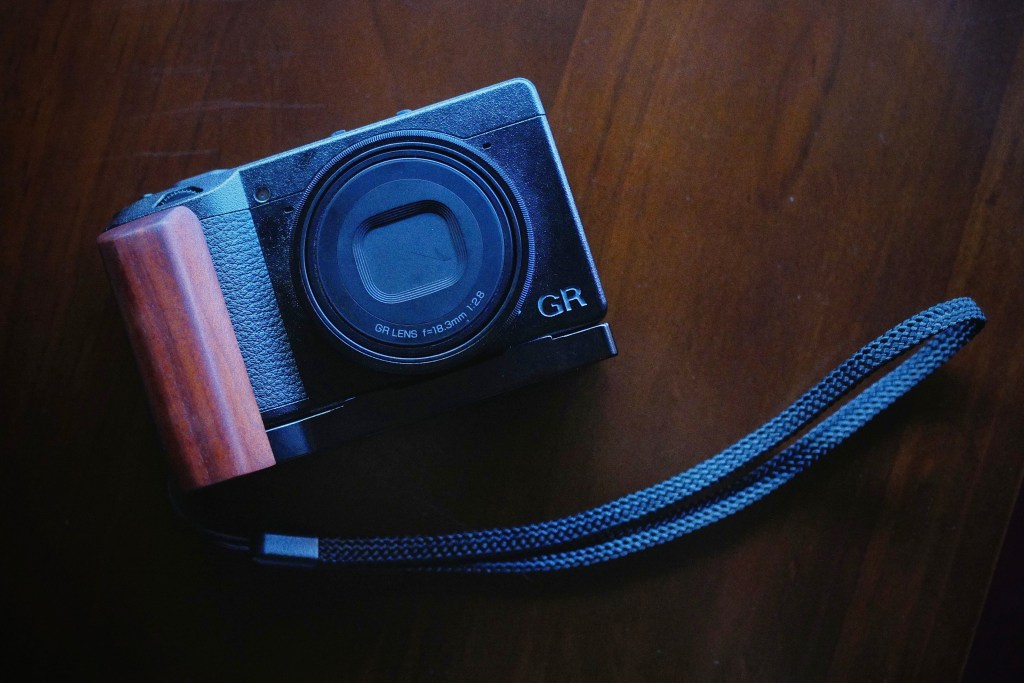
The design harks back to earlier film compacts, of course, and has remained remarkably consistent. That means the look of the camera is rather nineties, surprising in the current era of boring bricks. It’s made to slip in and out of a pocket without snagging on anything, which means that it has no protruding edges anywhere on the camera – a mixed blessing, since it can be hard to hang onto sometimes. I highly recommend getting one of the available thumb grips which mount via the hot shoe. Mine is made by JJC and serves its intended purpose perfectly.
One-handed controls don’t mean that it’s always easy to manipulate every control without engaging your other hand. The main rear toggle and front dial are fairly easy to confidently adjust, but some buttons fall in areas where you must lessen the sureness of your grip on the camera in order to interact with them. So, rather than risking your camera’s digital life, I recommend using your left hand to grab the other edge of the camera. The included wrist strap is very useful, but loose enough that you need to watch that it doesn’t slip up over your hand. I use an inexpensive wrist strap which cinches close to my wrist for safety.
Speaking of dropping the camera, this might be one of the most drop-prone cameras I’ve ever used. I’m generally quite careful with my devices, but there’s something about how small and unassuming the GR is that creates more of those “wrong place, wrong time” situations than other cameras. I’ve had a couple of serious spills onto concrete – ouch! Even so, durability hasn’t been a problem with this camera. Despite cracking a glass screen protector (you should use them, by the way) and a couple of dings to the black-painted magnesium alloy, the GR has stood up like a champ.
This isn’t to say that there are no mechanical problems with the GR III, because there unfortunately are. I’m not going to get too far into the often-trotted-out sensor dust controversy. Suffice it to say that yes, you can still get dust on the sensor despite the addition of the sensor-shake dust reduction system. That said, it seems to be less prominent in examples I have seen than with the older GR II. The main danger of dust in the GR cameras, however, isn’t on the sensor but rather in the back of the lens assembly, close to the sensor, which itself sits behind a clear glass pane. The lens assembly moves in and out, potentially sucking dust into the gaps, where the sensor shake mechanism has no effect. However, the further dust sits from the actual sensor, the less defined it appears, especially at larger apertures. This in itself, combined with the sensor shake mechanism to combat dust ingress from the other side of the camera, which might reach the actual sensor, makes the GR III less problematic than the previous models.
The main problem I have had with the GR III is not dust, but the rear dial, which sits around the four-way controller and serves to scroll through menu items and adjust ISO when the ISO button is pressed. It was also the cause of the “wobbly dial” complaint early in the GR III’s product cycle. The wobble itself, which I experienced with my early camera, was not that big of a deal – but the rear dial’s propensity to intermittently stop functioning as a scroll wheel was and is a real issue. I have seen enough complaints about this on the internet to conclude that it has nothing to do with the early wobbling of the same dial, since later manufactured cameras have slightly tighter dials with less wobble, but may still stop responding to rotational input. In my case, the issue could always be fixed by spinning the dial vigorously before operating it, but it was inconvenient at the least and sowed the seed of doubt as to the dial’s continued rotational function. I have not seen Ricoh address this at all, but I suspect it will grow to be more of an issue as the cameras age. It may be something as simple as dirty contacts, but cleaning the dial would require opening up the camera, which Ricoh’s American service contractor, Precision Camera, wants a fair bit of money to do if the camera is out of warranty.
This brings me to my main piece of advice concerning the GR III: that you purchase an extended warranty or service contract. I am usually against these, but my experience leads me to believe that the GR III has a better chance than many other cameras of needing serviced during its lifetime. Rather than taking to the internet forums to trash-talk the camera, or selling it and trying to make do with something else, I chose to make peace with the fact that I may be without the camera for a short period at some point along the way, and paid an extra $60-$80 to cover the likelihood of an otherwise expensive repair.
This puts the GR III in the same category for reliability as some film cameras, which need CLA’s at intervals to keep them running. This might be unacceptable for some, but since the GR III is in current production and parts will no doubt be available for quite some time into the future, servicing should be seen more as a necessary occasional event to keep the camera humming along smoothly. Incidentally, professional photographers often have their cameras regularly serviced for lesser issues simply to make sure they will not fail in the field. The GR III issues are not sudden-onset: you will notice the issue developing over time, and can work around it if you need to keep using the camera. Then send it in for servicing when you get a chance.
I didn’t initially expect to spend this much time talking about the GR III hardware, but it is a bit more complicated in this respect than, say, a Panasonic Lumix. In future installments I’ll write more about the shooting ethos of the GR, and the excellent image quality.
 The Sprocket Docket