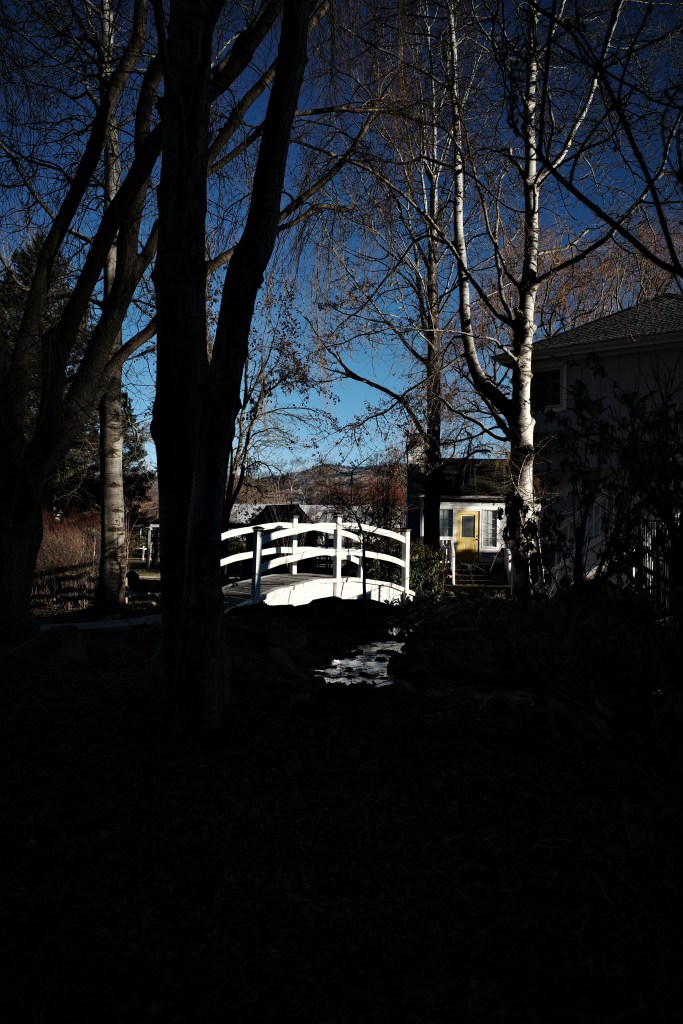
Last time I wrote about the power to surprise and arrest us that a photograph has by being printed and placed into real-world surroundings. But what if we want to make photographs to appear in a book, or to try and capture a moment of the restless viewer’s time on the internet? We can do that easily with contrast, whether of shapes or colors or relative size of subjects and background. We can do it with broadly expansive gestures of the human form, with eyes prominently part of the scene (when do the eyes of a stranger not arrest us?). Even subtler effects, like leading lines working away into the background, can work as long as the overal impression of the photograph at first glance has a defined shape and dynamism. I find that looking at photographs in different sizes, distances or screen resolutions helps me determine whether that inherent dynamism is present at first glance. Otherwise it is hard for the photographer, who is so well-acquainted with the photo from creation to editing and on through to printing or posting, to see the forest for the trees (this metaphor can work literally).
My point is not to go over every concept that you can use to capture a first glance, to be surprising or arresting. You can workshop this all over the web, and in books. Remember how common how-to manuals are in the photo book world. Use those to your advantage.
Surprise is not enough to make your photos really impact the viewer, though. It serves to buy you the time for the viewer to consider the content of the photograph, and that’s where you have to have something more left to show. This is such a big part of the challenge of creating good photographs – you have to be on the lookout for the meaningful moment, or the telling gesture. To read a scene and see what others missed, or to make commentary that smacks your viewer, either challenging or affirming something which they believe about the world. But at the same time you have to be shaping things with that arresting, geometric, compositionally appropriate entry point to lead the viewer into considering the rest of the story. The combination of those two things on the fly, or inside of the time and space that you have set aside with a subject, presents the difficulty wherein a photographer shows his or her mettle. It separates the photographer from the picture-taker.
All the same, the most innocent lamb with a camera can take a photo that works on all these levels. They just won’t do it very often. This does present us with a bit of breathing room, because if we learn to recognize what makes one of our photographs good, we can be very selective with what we show, regardless of how often we accomplish the goal. I phrased the previous sentence a specific way on purpose: what makes one of OUR photographs good. Because we usually default to judging our results by how closely they adhere to the good photographs of someone else, whether it be online feeds, famous photographs or our favorite mix somewhere along that spectrum. If we always evaluate with the unconscious bias of applying someone else’s framework to our photographs we will not only stifle ourselves by trying to only take those kind of photographs, but we’ll miss out on whatever we had to say that is new, original. We’ll think along a well-worn track and never see things outside of that packed earth.
You can try showing your photographs to people. I say try, because we often only do that on the internet, and it’s hard to get honest, detailed feedback that way. Especially when the online platforms are actively working against us, maliciously presenting the viewer with a stupid, rock-headed like button so we don’t even have to form any words to think we’ve made ourselves heard. We just wipe the drool from our slack-jawed mouth and click a mouse to move on from that photograph forever and forget anything that tried to struggle upwards through the gray matter.
You’re fighting an uphill battle, remember. Even just to see your photos for what they are, even more so to see the world for what it is. But that’s the war, for photographers. That’s what offers some actual self-improvement and what makes this worthwhile as a passion or a vocation.
 The Sprocket Docket