A couple of years ago, I wet my feet in the world of Pentax with a KP, a compact APS-C DSLR which was originally released in 2017. The KP marked a departure from the normal lineup of Pentax DSLRs, as a sort of midrange model which experimented with a different form factor, a few new controls, and an innovative swappable grip, which came in the box with small, medium and large grips. The KP marked both a first and a return for me: the first time using Pentax cameras, and a return to a DSLR after my first serious digital camera, a Nikon D40, purchased in 2006.
There were a couple of reasons why the KP did not stay with me for very long. One reason was the optical viewfinder, which was not as large or bright as I wanted. I came back to the DSLR fresh from experiences with rangefinder optics, which are bright and clear and made up of only a few components, and electronic viewfinders, which offer a through-the-lens look, and, depending on their quality, a sharp, high-resolution peek into what the final shot will look like. Moving from this to a mirror reflex design on an APS-C format was a little dissatisfying. The size of the sensor corresponds to the size of the mirror, meaning that there is only so much light being reflected up through the pentaprism to the viewfinder. Also, brightness is dependent on the maximum aperture of the lens you are using. When I was younger, and perhaps knew of nothing better, this did not bother me, but now my eyesight is a little worse, and I am spoiled by more modern technology.
However, going back to that “first” I mentioned above, the KP introduced me to the world of Pentax. A famous camera brand of yore, they have marched to the beat of their own drum for a long time now, releasing cameras which often try out new innovations in design or handling. Sometimes they work well, sometimes not so much, but they’re always willing to try things. Also, Pentax never really got caught up in trying to match Canon or Nikon, the big players on the DSLR playground. As such, the ethos of Pentax cameras has emphasized different things for a while now. Technology which the big players were slow to embrace, like in-body image stabilization (IBIS) and high-resolution sensor shift, features which are already familiar to me as a micro four thirds user, have been in Pentax cameras for a long time, offering a little extra to stills-focused photographers. And that’s only the start. Pentax also offers a unique lineup of lenses called the Limited series, with sub-lines for both full-frame and APS-C, with unique focal lengths like 15mm, 21mm, 70mm in APS-C and 31mm, 43mm and 77mm in full-frame. These are lenses built for unique rendering and small size, and are designed with a high attention to detail.
Users of Pentax equipment are usually very enthusiastic about their choice of gear, and are frequently called Pentaxians, a term that conveys almost a religious sense, or that of a close-knit early ethnic group, like people Odysseus might have met on his journey home from Troy. They are a bit of an odd bunch, if only for their deep knowledge and strong attachment to an ecosystem of camera equipment that’s all Greek to many other photographers. Since owning and using the KP, I began to feel a call to return to this slightly misfit group of enthusiastic photographers with their mystic knowledge. You might say I was in danger of becoming a Pentaxian.
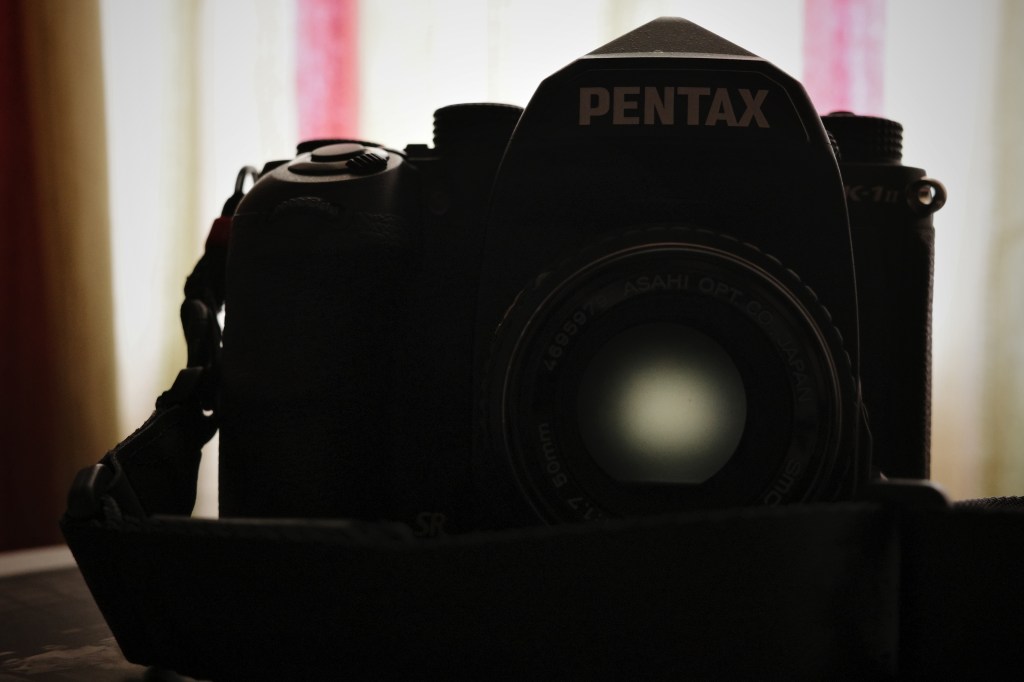
The camera which had been calling to me for a long time was the K-1, and its look-alike, minor refresh the K-1 mark II. Pentax’s first full-frame 24X36 format camera, it originally released in 2016, a year before the KP, and was the template from which some of the KP’s controls were derived. It also contained a wealth of high-end features. Pentax was late to the party with their full-frame release, but they threw in everything they had to make it a compelling camera. It was also affordable, considerably under $2000 for a flagship full-frame camera model. No corners were cut in the K-1, there was no fancier camera for which to withhold features (a technique common in the DSLR lineups from competitors), unless one were to count Pentax’s medium format digital cameras, which Pentax thankfully did not seem to think of as competing internally with their other formats.
Enter the pandemic, supply shortages, and rising costs for things like 35mm film. Overnight I saw my cheap option for black and white shooting, the excellent Fomapan film stocks, jump in price. Fomapan 100 36 exposure rolls went from $4.99 to $6.29. Hundred-foot rolls of Fomapan, the truly cheap way to do things, went from $49.99 to $69.99, and many times film was altogether out of stock. Color film from any manufacturer is still well-nigh impossible to get, and costs much more than it did before. These prices, combined with less free time, really put a damper on my film shooting over the past year. I began to think about the feasibility of putting film shooting on hold, and finding a digital camera which could replicate some of the enjoyment of shopping in a manufacturer’s back catalogue of film-era lenses. What camera offered a seamless way to do this? That’s right, the Pentax K-1.
I bought the camera a little over a month ago, and, though I have not had a whole lot of time to shoot with it, I am already loving what I see. As time allows, over the next few months I will be exploring the features, image quality and shooting experience of this uncompromisingly photographer-oriented camera, as well as some of the age-old classic lenses in the Pentax stable. Yes, while the FA Limited lenses beckon to me on the horizon, the most compelling ones I have found are manual-focus lenses like the Pentax-M 50mm f1.7, a lens that’s as sharp on a massive 36mp digital sensor as it ever was on 35mm film. The fact that SLR lenses of yore typically command some of the lowest prices today, and that Pentax has been building them to a very high standard for well over fifty years, has me more interested than simply shopping for the best sharpness, microcontrast or bokeh in a given focal length.
Of course, not all of us are made of money, and even though the K-1 II was affordable as full-frame cameras go, it was still a large expense. The purchase is coinciding with downsizing in my film camera lineup. I have yet to decide which cameras will be sold on to other users, but I will probably not be shooting film all that often for a while. We’ll see which camera or cameras survive the cut.
 The Sprocket Docket