This is the second of my posts around the Pentax HD DA 15mm f/4 Limited. In the first, I was concerned with the characteristics of wide and ultra-wide lenses in general, for the most part, and promised to get more technical in the second one. As I thought about it, however, I realized that I’m not that concerned about learning the technical minutiae about this lens: how sharp it is relative to other, similar lenses, how much distortion there is, etc.
I think it’s because the lens easily crosses the threshold of “good enough,” such that I am just not concerned about the margins, the edge case scenarios. That’s pretty common with Pentax in general. They have a certain character which makes splitting hairs unimportant to the user. So, the level of technicality in this entry might be disappointing for some people. That’s nothing new with my blog, truth be told.

This doesn’t mean that I don’t have specific notes about the performance of the lens, though. I have a few. First of all, let’s talk about autofocus. The 15mm Limited is an ultra-wide lens by my standards, which means that it has very large depth-of-field. Couple that with the relatively slow maximum aperture of f/4, and the fact that the APS-C sensor has more depth-of-field by nature, and that means you usually don’t have to sweat fine focus accuracy that much. Still, I find the lens to focus very quickly, for a K-mount screw-drive lens. Certainly much faster than the HD FA 43mm f/1.9, and a little faster than the HD FA 31mm f/1.8. Even so, I make use of a little tweak which I first implemented when looking to speed up the performance of the FA 43mm: release-priority AF. This means that half-pressing the shutter button will focus the camera, but fully depressing the button will take the shot, regardless of whether the camera thinks the focus has acquired complete accuracy.
The behavior of autofocus is such that the initial, fastest movement of the focus mechanism will be to approximate the correct distance to the subject, followed by some smaller movements to fine-tune focus. Sometimes, especially when you have large depth-of-field, those smaller adjustments aren’t wholly necessary. Often, they can take some time, meaning you might miss a brief moment. With the FA 43mm, I usually stop down to around f/6.3-f/11, depending on the light, so I have some depth-of-field to work with. I’ll half-press, and as soon as I ascertain through the viewfinder that my subject is in “pretty good” focus, I’ll fully depress the button and take the shot. Usually, this works – not always, but I’ll take the error rate, It’s similar to manually focusing on the fly, which I have done a fair amount of. In fact, you could say there’s an element almost of manual focus about this method, since I’m not letting the camera call the shots all of the time in terms of when to take the photo.
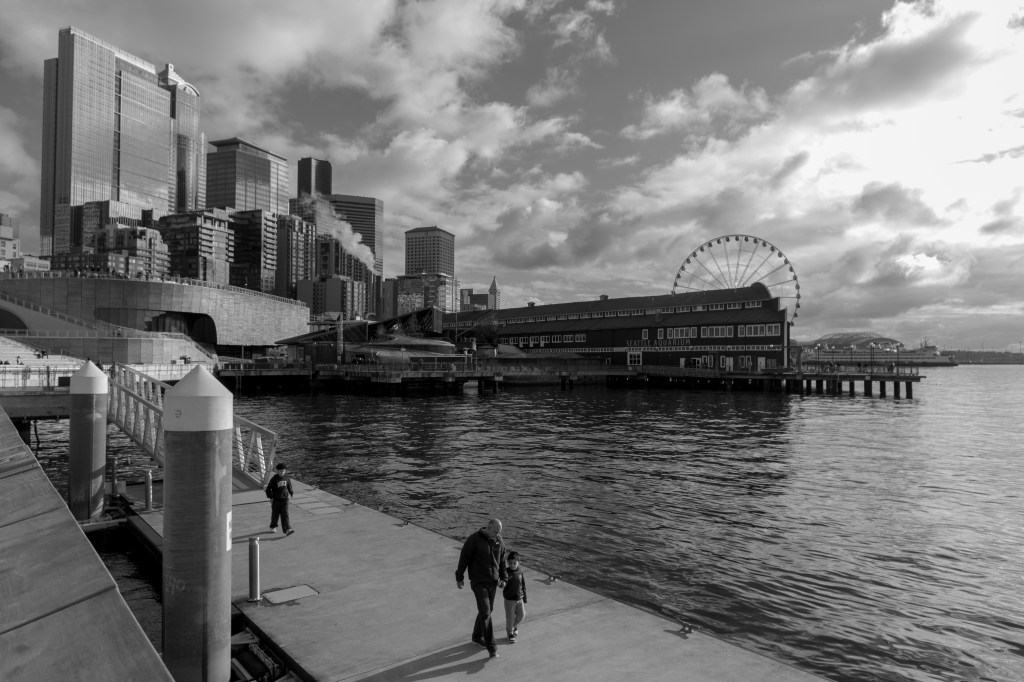
With the DA 15mm, depth-of-field is so large that it’s almost a foregone conclusion that the subject will be in good enough focus almost as soon as the autofocus mechanism has started working. There’s a certain amount of muscle memory to be learned in the process, but it’s not terribly difficult to become familiar with the behavior of the autofocus, and to fire off shots almost as fast as zone focus, which is something I also do sometimes with this lens, to good effect (though less often, in this darker winter season in the rainy PNW).
I have also found that, for whatever reason, I use the full focus points of the K-3 Mark III Monochrome. I believe autofocus systems are always somewhat biased to focus on something in the foreground over the background. And, when shooting an ultra-wide lens (at least on the street) I am almost always focusing on closer subjects. So, the auto-area AF gives me what I want almost all of the time. One of my other main techniques is to use single-point center focus, and recompose where necessary. This works great with longer lenses, but it’s seldom usable with an ultra-wide. There is just too much going on in a frame this size to put your main area of focus dead-center. And recomposing with an ultra-wide is easier said than done: you open up so much margin for error that it is best to stick close to the frame you saw in your mind’s eye before you put your eye to the viewfinder.

The DA 15mm has quick shift focusing, meaning that, with the shutter button half-pressed, you can override the focus point by moving the focus ring. Is that useful for anyone? It isn’t for me. I find it’s all too easy to accidentally half-press again after making the adjustment, leading to a repeat of the process. It’s just not a necessary function for me, so I definitely don’t see the lack of quick shift on some of the other lenses (the FA 31mm and 43mm) as detrimental.
A small note about distortion: it’s usually going to be present in some part of the image. Such is the nature of these lenses (especially compact lenses of this focal length, which have fewer optical corrections). The key is not to compose in a way that makes the focal point of your image distorted. That means, for one, that it’s best to keep the lens level, to the best of your abilities. If it’s on as natural of an axis as you can make it in the moment, then things are going to show less distortion, except near the edges, which is an area that you have to be very careful about putting your focal point. Ultra-wide lenses like this needn’t always have a ridiculous amount of distortion, and what’s there is usually something I find enhances the character and gives a bit of you-are-there immediacy. But you have to keep it under control, or, like a fast car, things can get away from you.
This is a sharp lens. It’s not the most clinically sharp, but then, neither are most of the other Pentax lenses with the Limited badge. They can be very sharp, especially stopped down, but that’s not the main object in their design. Rather, it’s good bokeh, interesting character, classic feel, and 3D pop. Which last, let’s remember is at least sometimes accomplished by the lens designers by allowing the focus plane to be curved, so there is more focus falloff towards the corners. I’ve never felt let down by the optical design of the DA 15mm. It feels like an artist’s lens, and challenges me to bring out an extra “something” in my images.
Of course, I have been exclusively using this lens on a monochrome camera. It’s a lens known for excellent color rendition, and I’m not doing anything which allows me to appreciate that. I’ve put the lens on my K-1 Mark II, but, as it’s a compact APS-C ultra-wide, it has a lot of vignetting on a full-frame sensor. The K-1 can automatically enter an APS-C crop mode, a wise feature for Pentax to put in their first full-frame camera, since they spent the whole first part of the digital age mainly manufacturing APS-C lenses and bodies. But, given the DA 15mm’s very wide frame, the cropped box in the K-1’s viewfinder feels very small, and harder to compose inside of. I’ll no doubt give it more of a workout on the K-1 when the light, and the weather, improves later this year.
So there you have my shooting impressions, which are not quite technical, but are (I hope) concrete enough. Is this a good lens? it is, to be sure. is it fun to shoot with? Yes indeed. Is it easy to use well? Maybe not, but I enjoy the challenge to see better and shoot better in ultra-wide, and monochrome.
 The Sprocket Docket