You don’t need to go too far down the home page of this website to see a post about the Pentax K-3 Mark III Monochrome. In that post from May, I made it quite clear that my short time with the camera (in February) left me wanting to keep it and shoot much more with it. Recently, I swallowed the bitter pill that is the price tag (albeit used, with a decent discount, from a large photography retailer) and brought it home for the second time.
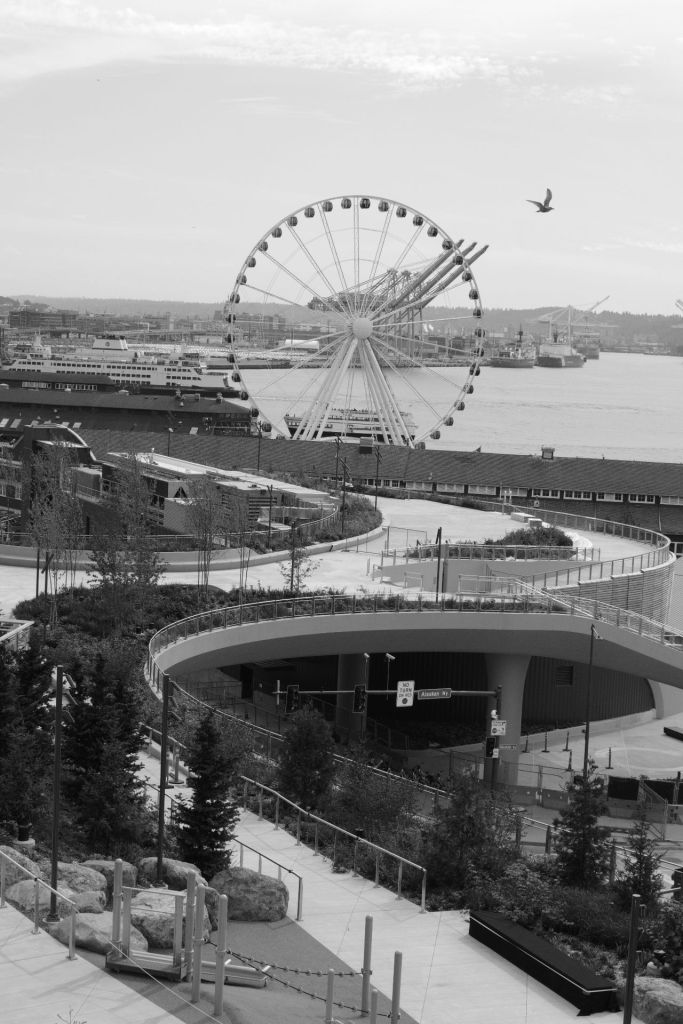
There are a number of minor conveniences which swayed my decision slightly – they are the products of the camera being relatively new compared to my K-1 Mark II: faster autofocus, faster startup time, faster Wi-Fi transfer, more responsive live view, USB-C charging, highlight-weighted metering. But none of these were decision-makers, nor even the combination of all of them. Rather, the character of a monochrome-only sensor was itself the only real selling point for a camera such as this.
I can split the monochrome sensor into two main areas of advantage: native rendering of the sensor, and post-processing. Both are subjects I touched on in my previous post, so I only want to go a little further in-depth for this one.
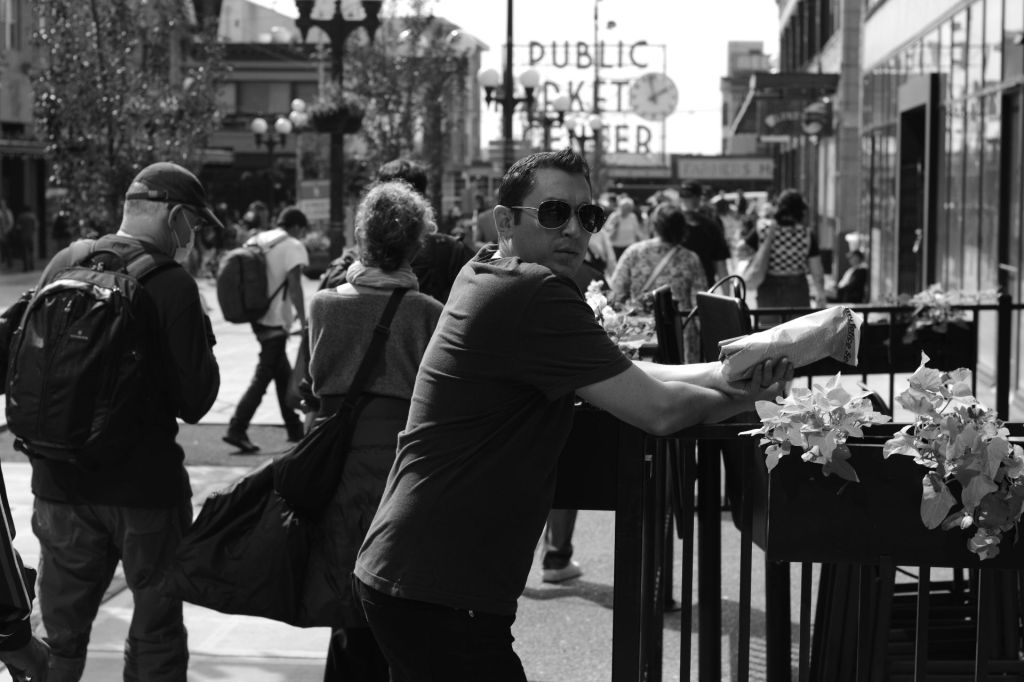
First, the rendering, or output, of the 25-megapixel APS-C monochrome sensor. What makes it extraordinary, for me, is the result at very high ISO values – which, incidentally, I find myself needing fairly often when I shoot street photography. In the downtown areas of Seattle, lighting frequently dips down into regions that Bayer-color sensors struggle at. Sometimes there is strong sunlight, but harsh shadows created by tall buildings. Sometimes I am indoors. Often, the weather is overcast, so that shadowed areas are even darker, while the tall buildings prevent the typically diffused evenness of cloudy days. Most of these situations lend themselves better to monochrome photography than color, already. The added sensitivity of the filter-less monochrome sensor captures extra light, while the absence of chroma noise and the lack of interpolation means that details remain sharp even when the ISO ramps up and the image becomes grainy. I have found the grain out of camera to be the most pleasing digital noise I have ever seen in a camera (even at ISO 51,200!). The images take on some of the same looks as pushed B&W film, which creates some consistency with my analog photographs, without resorting to adding grain in post.

I’d like to add a note, specifically about the APS-C format in comparison to full-frame. In my previous post, I compared the detail favorably to the K-1. I’ll stand by that – but I want to note that the full-frame camera still produces images with a “feel” not quite matched by APS-C. I’ve yet to identify exactly what produces this feeling, but I suspect it has to do with a combination of depth-of-field and transitions between sharp focus to out-of-focus, as well as transitions between tones (and, in the K-1’s case, shades of color). As sensors get smaller, the transitions become more abrupt. I’ve often noted that these transitions aren’t as pleasing on Micro Four Thirds, though I find that format to produce sharp, slightly gritty, and quite high-quality images. There is a noticeable improvement when stepping up to APS-C, particularly when using good glass (lenses are part, but not the whole, of the equation). The images produced by the Ricoh GRIII models demonstrate this well. But, when making images with the K-1 Mark II and a good lens, such as the HD FA 31mm f1.8 Limited, I am always struck by a sense of depth in the images. In my head (though this doesn’t make a lot of sense) I liken this to being able to take a deeper breath, such as after exercising strenuously outdoors, compared to the relatively shallow inhale that one is able to make when sitting at a desk in an office. It’s the visual equivalent of added space, added effortlessness, added oxygen.
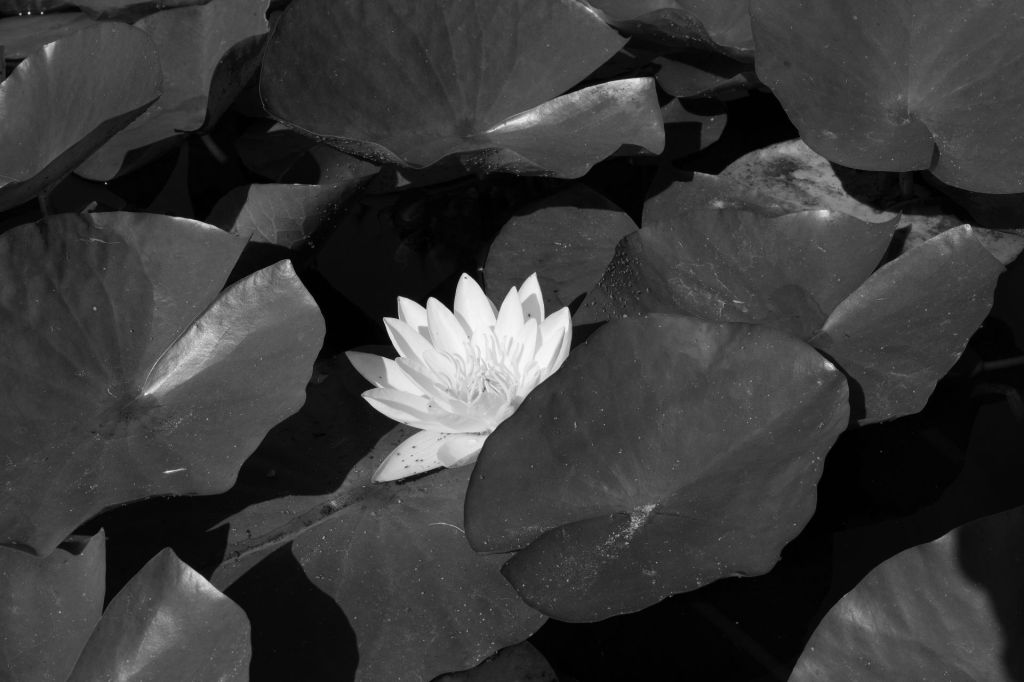
What the K-3 III Monochrome has is an amazing level of fine detail, tonal range, and sensitivity. In fact, I think its capacity for capturing subtlety in a scene is equal with the K-1. The values, if we were weighing many fine aspects of the scene, are not identical, but they add up to the same number. I do not feel that comparing this camera to a full-frame camera is correct, yet I do not perceive one as inferior to the other. They are simply different.
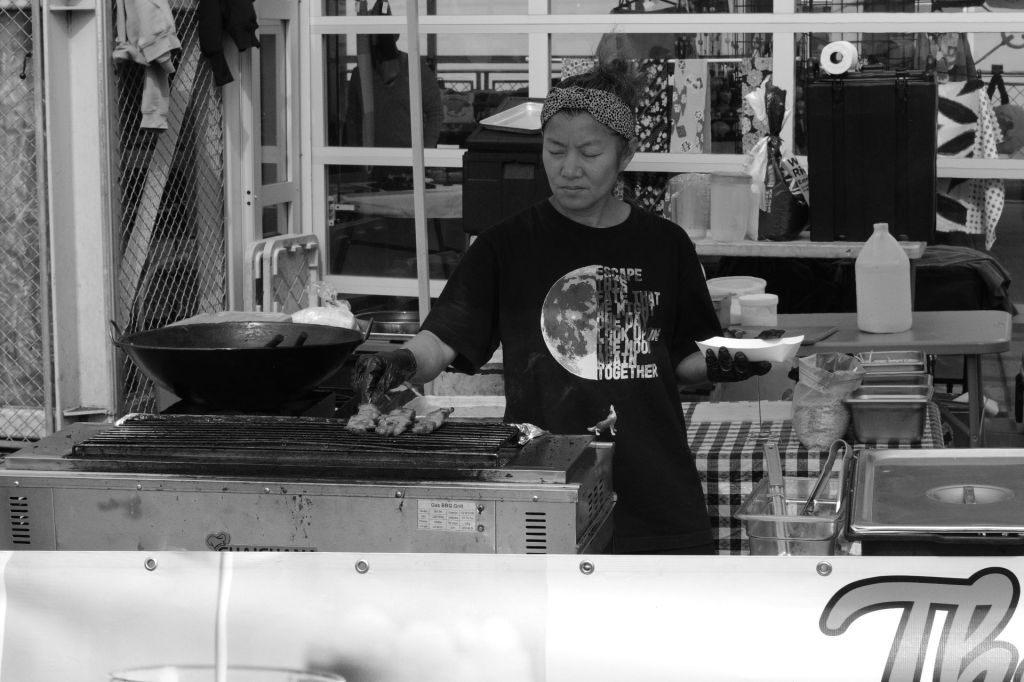
On to the second advantage of the camera: the post-processing. I wrote last time comparing the process of editing color RAW files into monochrome JPEGs with the editing I tended to do with the native monochrome RAWs. That has held true with continued use. I typically only edit the tone curve, adjusting the bright and shadowed portions of the image, along with some global contrast. Compared to the time-consuming process of editing color RAW files, first in Lightroom or PhotoLab, then in Nik Silver Efex, this is lightning-fast. Propounding the matter, I have many film simulations and other effects I could apply in Silver Efex, which tends to result in a wide variety of finished looks, a lack of coherence between shots (even those shot at the same time, perhaps minutes apart, with the same equipment) which bothers me. I am sometimes happy with the B&W JPEG files from the Ricoh GRIIIx, and feel no need to edit these further. But the GRIIIx files only retain fine detail up to ISO 6400, perhaps 8000 in a pinch. In low light, I usually need to process from RAWs.
Silver Efex also requires working from TIFF, which is an added layer of file management that I don’t approve of, and TIFFs can be quite large files.
So, there you have it: more writing on the Pentax K-3 Mark III Monochrome, and the promise that it will continue to crop up in future posts. I’ve been using it extensively for short bouts of street photography on my lunch breaks at work, and for general photography whenever I get the chance.
 The Sprocket Docket
well, I have to admit I just don’t get it. From all the reviews I’ve read on the monochrome Pentax, the differences are so subtle that I can’t see them. I shoot with a K-1, K-3, and other Pentax and Nikon bodies, and even the oldest ones can produce stellar results. Add some selective post-processing/editing, and the averge viewer can’t tell the difference. I’d really like to see some comparisons between, say, a K-1, K-3 and K-3 monochrome that clearly shows why I should spend the bucks on a mono only body….
LikeLike
Well, I don’t enjoy pixel peeping comparison tests, and most of what’s involved is honestly subjective: what levels of noise you accept, or how long you’re comfortable post-processing, etc.
I will say that I was skeptical as well until I tried out the camera for myself. That’s when it got its hooks in me.
It might be worth trying to do a comparison with the K-1 II, however, since I have that camera. Stay tuned and I’ll see what I can come up with!
LikeLike
I have a k1ii and now the K3iii monochrome, which my Sigma Art 35 mm lives on, am loving the challenge of getting “more” from “less”.
LikeLike